

Trading Terminology Every LiquidLvy Member Must Understand
LiquidLvy Foundation Series — Part 3
Trading Terminology Every LiquidLvy Member Must Understand
Understanding liquidity changes how you see the market.
But to follow what price is doing in real time, you need something else:
You need the language.
Why Terminology Matters
Most traders look at charts and feel confused.
They see movement.
But they cannot explain it.
LiquidLvy traders do not guess.
They describe what is happening.
Instead of saying:
“Price is going up”
You say:
“Price is moving into buy-side liquidity above the previous high.”
Language creates clarity.
Clarity creates discipline.
The Core Terms
These are the foundational concepts every LiquidLvy trader must understand.
1️⃣ PDH and PDL
PDH (Previous Day High)
PDL (Previous Day Low)
These levels represent key liquidity zones.
Above PDH:
🔹 Buy stops sit
🔹 Breakout traders enter
Below PDL:
🔹 Sell stops sit
🔹 Panic sellers enter
These are not just levels.
They are targets.
2️⃣ Liquidity
Liquidity is where orders exist.
It is found:
🔹 Above highs
🔹 Below lows
When price moves into these areas:
Stops are triggered.
Orders are filled.
This is called a liquidity event.
3️⃣ Buy-Side Liquidity
Buy-side liquidity refers to stops resting above highs.
When price trades above these highs, it is often targeting those resting buy stops.
This behavior is common in intraday futures markets such as ES, NQ, and CL.
4️⃣ Sell-Side Liquidity
Sell-side liquidity refers to stops resting below lows.
Price may trade below these levels to trigger sell stops before shifting direction.
5️⃣ Liquidity Sweep
A liquidity sweep occurs when price moves into a level to trigger stops.
For example:
🔹 Price trades above PDH
🔹 Buy stops are triggered
🔹 Liquidity is collected
To most traders, this looks like a breakout.
But it is often a setup.
Liquidity is the fuel. Structure is the engine.
6️⃣ Market Structure Shift
A market structure shift is a change in directional control after liquidity is taken.
This occurs when price breaks a prior swing level following a liquidity event.
It signals that control may have changed.
7️⃣ Imbalance (Fair Value Gap)
An imbalance forms when price moves too quickly.
These rapid displacements create inefficient areas in the market.
Price often returns to these zones to rebalance.
Structure Terms (Preview)
These terms describe how price behaves after liquidity is taken.
They will be explored in depth in the next article.
Break of Structure (BOS)
A Break of Structure occurs when price moves beyond a previous high or low.
This suggests that the current directional move is continuing.
Change of Character (CHoCH)
A Change of Character occurs when price breaks structure in the opposite direction.
This suggests that the market may be shifting.
🔹 Displacement
Displacement is a strong, aggressive move in one direction.
It shows:
🔸 Urgency
🔸 Institutional activity
🔸 Real momentum
Displacement is not slow.
It is decisive.
Seeing It All Together
You are not meant to memorize these terms.
You are meant to see them.
Price moves like this:
🔹 Moves into liquidity
🔹 Sweeps stops
🔹 Shifts structure
🔹 Displaces
🔹 Leaves imbalance
🔹 Continues toward the next target
This is not random.
This is the sequence.
Terminology in Action
Below shows this sequence clearly:
🔹 PDH is taken
🔹 Buy-side liquidity is triggered
🔹 A liquidity sweep occurs
🔹 Price reverses
🔹 Structure shifts (Market Structure Shift / Break of Structure)
🔹 Displacement begins
🔹 Imbalance is left behind
This is the sequence LiquidLvy traders learn to recognize in real time.
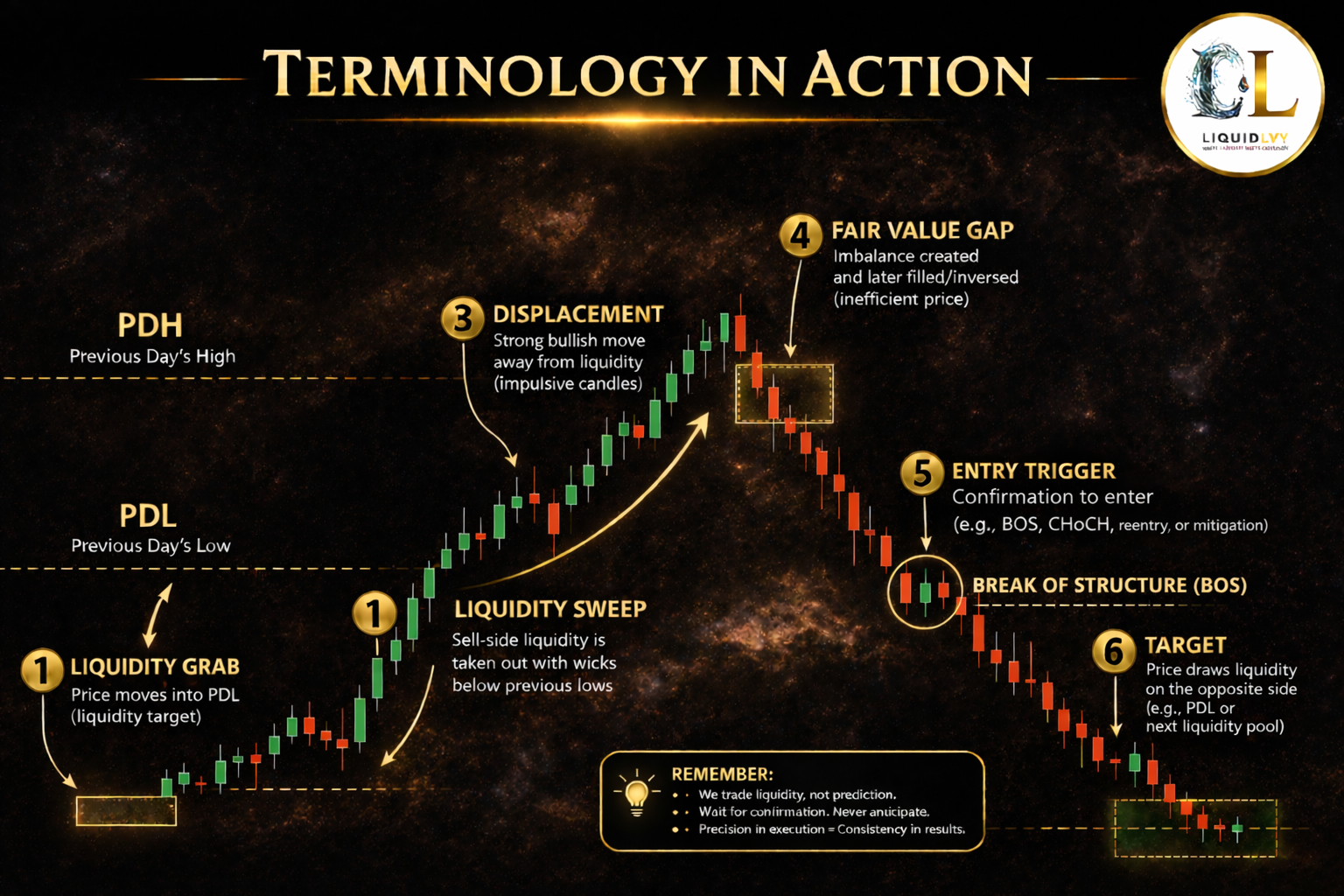
Sequence (step-by-step):
1️⃣ Price moves into PDH (liquidity target)
2️⃣ Buy-side liquidity is triggered
3️⃣ Price reverses
4️⃣ Displacement begins
5️⃣ Break of Structure (MSS/BOS)
6️⃣ Imbalance (FVG) forms
7️⃣ Price continues toward sell-side liquidity
The 6 Stages of Price Delivery
The sequence you just saw is not random.
It follows a structured cycle used by the market to move between liquidity.
To fully understand it, you need to see the complete model.
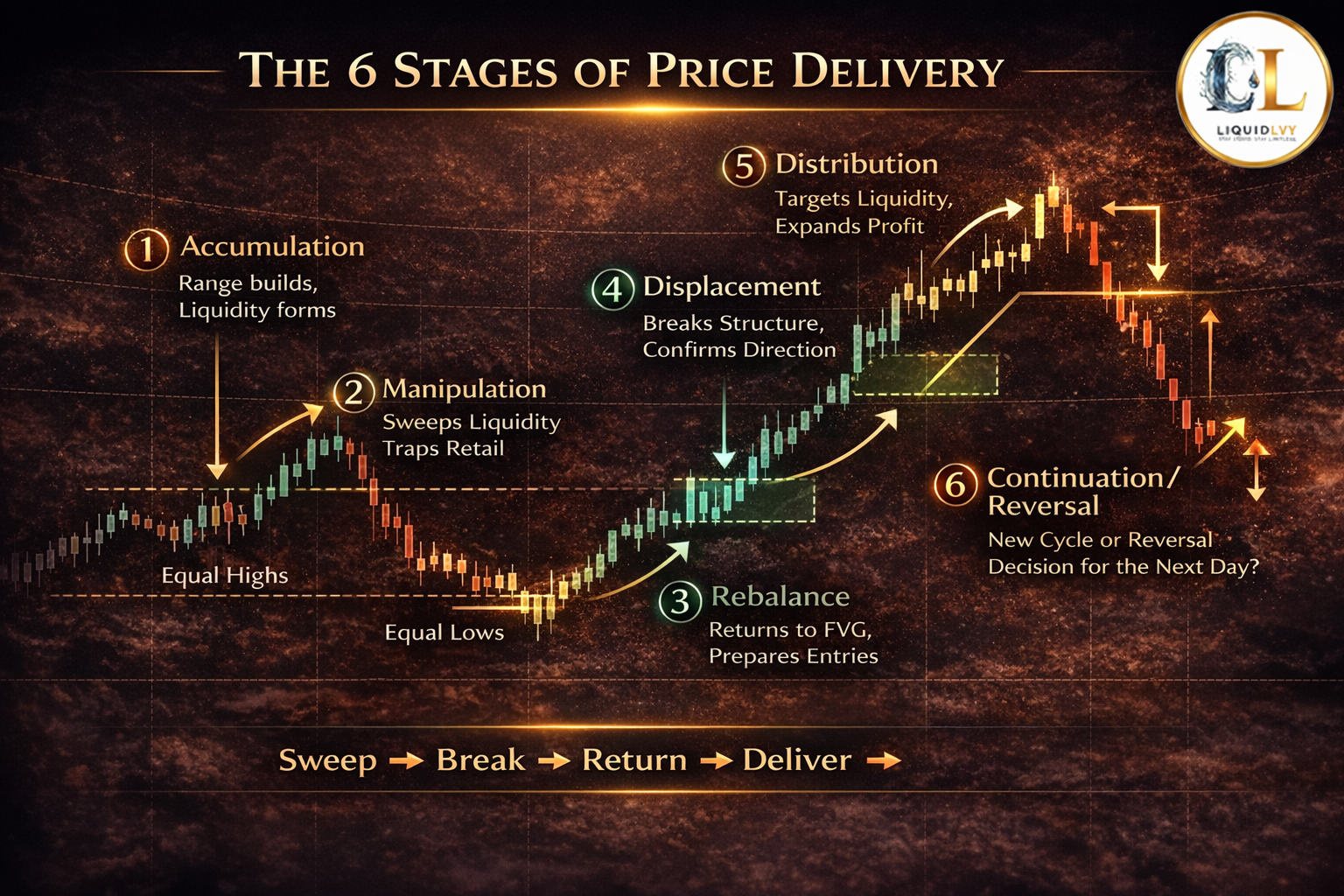
1️⃣ Accumulation — liquidity builds in a range
2️⃣ Manipulation — liquidity is swept and false direction is induced
3️⃣ Rebalance — price returns to inefficiencies (FVG), forming the optimal entry zone
4️⃣ Displacement — Break of Structure (BOS) confirms direction
5️⃣ Distribution — price delivers to opposing liquidity and expands profit
6️⃣ Continuation or Reversal — the cycle repeats or shifts
This is the underlying logic behind every setup.
LiquidLvy traders do not chase price — they identify the stage.
LiquidLvy traders learn to recognize where price is within this cycle before entering any trade.
Without terminology, you are reacting.
With terminology, you are interpreting.
Without terminology, charts feel random.
With terminology, charts feel mechanical.
You begin to see:
🔹 Where liquidity is resting
🔹 When it is taken
🔹 When structure shifts
🔹 When participation becomes logical
LiquidLvy traders map liquidity and structure before considering entry.
Understanding the language allows you to see the sequence.
Beginner Reminder
Do not rush terminology.
Understanding precedes execution.
Precision builds confidence.
Confidence builds discipline.
Day 3 — Continue the Foundation
Begin with this class:
Trading Terminology (ICT Concepts)
Continue through the playlist in sequence.
Each lesson builds on the last.
Progression builds edge.
Closing Perspective
Vocabulary builds vision.
Vision builds discipline.
Discipline builds longevity.
Master the language before mastering the market.
What Comes Next
Now that you understand liquidity and market structure, the next step is learning how price moves rapidly between those levels.
Those movements often leave behind imbalances in the market, commonly known as Fair Value Gaps.
Understanding those gaps is one of the most important skills for execution.
In the next article, we will explore how these imbalances form and how traders use them to identify high-probability entry zones.
Foundation Series Navigation
🧑🎓 Foundation Series
Last Lesson → 2
Next Lesson → 4
Full Series:
Start Here → 1 | 2 | 3 | 4 | 5 | 6 | 7 | 8 | 9 | 10 | 11 | 12
Video Lesson
Watch the lecture associated with this lesson: