
New LiquidLvy Members: Start Here
LiquidLvy Foundation Series - Start Here
Progression before profit.
Every serious trader begins here.
LiquidLvy is built on progression, not impulse.
If you skip steps, you create confusion.
If you follow structure, you build clarity.
This is where you learn how to think, not just how to trade.
The LiquidLvy Development Phases
LiquidLvy Trader Development Phases – Progression Before Profit
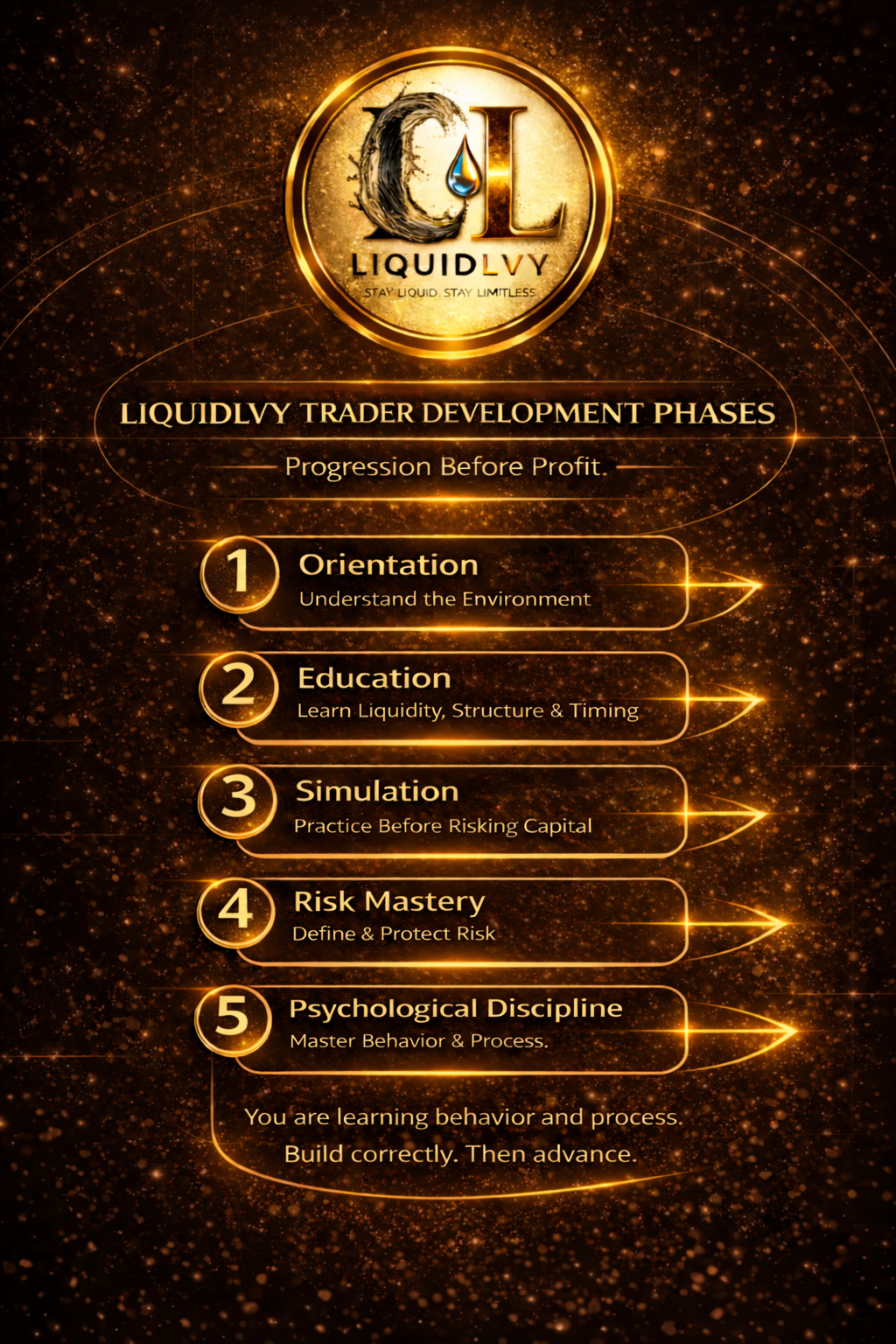
The LiquidLvy Trader Development Phases illustrate the structured path new traders follow:
orientation, education, simulation, risk mastery, and psychological discipline.
Phase 1 — Orientation
In real trading:
Most new traders rush into the market.
LiquidLvy traders wait.
No understanding = no trade.
Understand the environment before participating in it.
If you trade before understanding structure, you are not trading; you are reacting.
Day trading is a structured, zero-sum environment. Institutions, algorithms, and professionals compete for liquidity.
Your first objective is awareness.
Not profit.
If you rush, you donate.
If you slow down, you learn.
Phase 2 — Education
In real trading:
Most traders learn concepts but apply them randomly.
LiquidLvy traders wait for alignment — liquidity, structure, and timing.
If these are not aligned, there is no trade.
No alignment = no trade.
Learn how price truly moves.
Inside LiquidLvy, begin with:
Beginner class recordings
Core ICT concepts
Liquidity terminology
Market structure foundations
You will learn concepts such as liquidity sweeps, order blocks, and market structure shifts. These ideas will be introduced step-by-step through the LiquidLvy Foundation Series.
We do not trade support and resistance.
We trade liquidity and reversals.
Phase 3 — Simulation
In real trading:
Most traders skip practice and go straight to live trading.
LiquidLvy traders prove consistency before risking real capital.
If you cannot follow your rules on paper, you will not follow them live.
No discipline in simulation = no discipline live.
Practice execution before risking capital.
Before trading live:
Paper trade
Use micro contracts
Practice stop placement
Practice break-even management
Paper trading builds:
Execution discipline
Risk control habits
Emotional awareness
If you cannot follow rules with simulated capital, you will not follow them with real capital.
Phase 4 — Risk Mastery
In real trading:
Most traders think about profit first.
LiquidLvy traders define risk first.
If your risk is unclear, your trade is invalid.
No defined risk = no trade.
Define loss before seeking gain.
Every trade begins with:
A defined stop-loss
A defined dollar risk
A calculated position size
Example:
MNQ moves $2 per point.
If your stop is 10 points, that is $20 per contract.
If you want to risk $200, you take 10 micros.
Risk is math.
Emotion enters only when math is ignored.
Capital preservation is the foundation of longevity.
Phase 5 — Psychological Discipline
In real trading:
Most traders lose control after a loss.
LiquidLvy traders step away and protect their mindset.
If you are emotional, do not trade.
No control = no trade.
Master yourself.
Becoming a professional trader means becoming a professional loser.
Losses are not failure. Undisciplined reactions are.
Do not:
Trade out of boredom
Go on tilt
Chase revenge trades
Compare your P&L to others
Not every day is a trading day.
Sometimes doing nothing is the highest-probability decision.
Stay in your lane. Build consistency. Respect your process.
LiquidLvy traders build discipline before advancing.
Market Awareness
Build a clean dashboard:
QQQ
SPY
The Magnificent 7 (Apple, Nvidia, Microsoft, Amazon, Google, Meta, Tesla)
Understand index weighting. When leaders move, the index moves. Context matters.
What To Do Next
Set up TradingView properly.
Paper trade micros.
Study liquidity patterns.
Risk small and consistently.
Track every trade.
Then move to Day 1.
Beginner day trading on futures requires structured progression, disciplined risk management, and a deep understanding of liquidity and market structure. LiquidLvy is built to guide new traders through that process step by step.
Day 1 — Begin Here
If you are serious about becoming a LiquidLvy member, start at the foundation.
Begin with this Day 1 class. Do not move forward until you understand it.
Futures Market Structure Class (Day 1)
Everything inside LiquidLvy builds on this class.
Do not skip it.
Do not rush it.
Build correctly.
Watch the breakdown here ↓
Futures Market Structure Class — Day 1
Foundation Series Navigation
🧑🎓 Foundation Series
Full Series:
Start Here → 1 | 2 | 3 | 4 | 5 | 6 | 7 | 8 | 9 | 10 | 11 | 12
Video Lesson
Watch the lecture associated with this lesson: